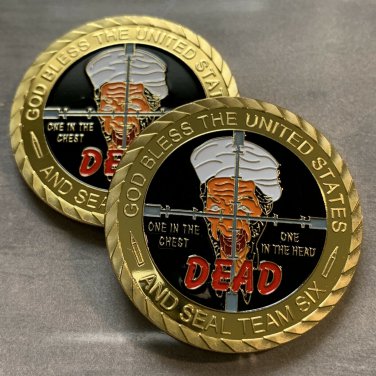
2 CHALLENGE COINS-GREAT PRICE!COMPARE AND SAVE! GREAT GIFT IDEA!2-Osama Bin Laden Kill Coins(One in the Chest, One in the Head)SEAL Team Six / 6 -September 11, 2001 9/11/01Mission AccomplishedMay 1, 2011US Navy Seal Team 6Commemorative Challenge CoinsSpecs: 40mm Diameter (1.625")Reeded Edge! Nice Coins! OPERATION NEPTUNE SPEAR:Osama bin Laden, head of the militant Islamic group al-Qaeda, was killed in Pakistan on May 2, 2011, shortly after 1 a.m. local time[1][2] by a United States special forces military unit. The operation, code-named Operation Neptune Spear, was ordered by United States President Barack Obama and carried out in a U.S. Central Intelligence Agency (CIA) operation by a team of United States Navy SEALs from the United States Naval Special Warfare Development Group (informally known as DEVGRU or by its former name SEAL Team Six) of the Joint Special Operations Command, with support from CIA operatives on the ground.[3][4] The raid on bin Laden's compound in Bilal Town, Abbottabad, Pakistan was launched from Afghanistan.[5] After the raid, U.S. forces took bin Laden's body to Afghanistan for identification, then buried it at sea within 24 hours of his death.[6]Al-Qaeda confirmed the death on May 6 with posts made on militant websites, vowing to avenge the killing.[7] Bin Laden's killing was generally favorably received by U.S. public opinion;[8][9] was welcomed by the United Nations, NATO, the European Union, and a large number of governments;[10] but was condemned by some, including Fidel Castro of Cuba, and the Palestinian Hamas leader of the Gaza Strip.[11] Legal and ethical aspects of the killing, such as his not being taken alive despite being unarmed, were questioned by others, including Amnesty International.[12]Locating bin LadenThe U.S. intelligence community effort to determine the current location of Osama bin Laden, which eventually resulted in the Abbottabad operation, began with a fragment of information unearthed in 2002, resulting in years of consequent investigation, followed by intensive multiplatform surveillance on the compound beginning in September 2010.Identity of his courierIdentification of al-Qaeda couriers was an early priority for interrogators at CIA black sites and Guantanamo Bay detention camp, because bin Laden was believed to communicate through such couriers while concealing his whereabouts from al-Qaeda foot soldiers and top commanders.[13] Bin Laden was known not to use phones, as the US launched missile strikes against his bases in Afghanistan and Sudan in 1998 (Operation Infinite Reach) after tracking an associate's satellite phone.[14]By 2002, interrogators had heard uncorroborated claims about an al-Qaeda courier with the nom de guerre Abu Ahmed al-Kuwaiti (sometimes referred to as Sheikh Abu Ahmed from Kuwait).[13] In 2003, Khalid Sheikh Mohammed, the alleged operational chief of al-Qaeda, revealed under interrogation that he was acquainted with al-Kuwaiti but that he was not active in al-Qaeda.[15]In 2004, a prisoner named Hassan Ghul told interrogators that al-Kuwaiti was close to bin Laden as well as Khalid Sheik Mohammed and Mohammed's successor Abu Faraj al-Libi. Ghul further revealed that al-Kuwaiti had not been seen in some time, which led U.S. officials to suspect he was traveling with bin Laden. When confronted with Ghul's account, Khalid Sheik Mohammed maintained his original story.[15] Abu Faraj al-Libi was captured in 2005 and transferred to Guantánamo in September 2006.[16] He told CIA interrogators that bin Laden's courier was a man named Maulawi Abd al-Khaliq Jan and denied knowing al-Kuwaiti. Because both Mohammed and al-Libi had minimized al-Kuwaiti's importance, officials speculated that he was part of bin Laden's inner circle.[15]In 2007, officials learned al-Kuwaiti's real name,[17] though they will not disclose the name nor how they learned it.[15] Since the name Maulawi Abd al-Khaliq Jan appears in the JTF-GTMO detainee assessment for Abu Faraj al-Libi released by WikiLeaks on April 24, 2011,[18] there was speculation that the U.S. assault on the Abbottabad compound was expedited as a precaution.[19] The CIA never found anyone named Maulawi Jan and concluded al-Libi made the name up.[15] A 2010 wiretap of another suspect picked up a conversation with al-Kuwaiti. CIA paramilitary operatives located al-Kuwaiti in August 2010 and followed him back to bin Laden's Abbottabad compound.[13] The courier and a relative (who was either a brother or a cousin) were killed in the May 2, 2011 raid.[15] Afterwards, some locals identified the men as Pashtuns named Arshad and Tareq Khan.[20] Arshad Khan was carrying an old, noncomputerized Pakistani identification card which said he was from Khat Kuruna, a village near Charsadda in northwestern Pakistan. Pakistani officials have found no record of an Arshad Khan in that area and suspect the men were living under false identities.[21]In June 2011 Pakistani officials revealed the courier's name as Ibrahim Saeed Ahmed from Pakistan's Swat Valley. He and his brother Abrar and their families were living at bin Laden's compound.[22]Bin Laden's compoundThe CIA used surveillance photos and intelligence reports to determine the identities of the inhabitants of the Abbottabad compound to which the courier was traveling. In September 2010, the CIA concluded that the compound was custom-built to hide someone of significance, very likely bin Laden.[23][24] Officials surmised that he was living there with his youngest wife.[24]Built in 2004, the three-story[25] compound was located at the end of a narrow dirt road.[26] Google Earth maps made from satellite photographs show that the compound was not present in 2001 but did exist on images taken in 2005.[27] It is located 2.5 miles (4.0 km) northeast of the city center of Abbottabad.[23] Abbottabad is about 100 miles (160 km) from the Afghanistan border on the far eastern side of Pakistan (about 20 miles (32 km) from India). The compound is 0.8 miles (1.3 km) southwest of the Pakistan Military Academy (PMA), a prominent military academy that has been compared with West Point in the United States and Sandhurst in Britain.[3] Located on a plot of land eight times larger than those of nearby houses, it was surrounded by a 12-to-18-foot (3.7–5.5 m)[24] concrete wall topped with barbed wire.[23] There were two security gates, and the third-floor balcony had a seven-foot-high (2.1 m) privacy wall, tall enough to hide the 6 ft 4 in (193 cm) bin Laden.There was no Internet or landline telephone service to the compound, and its residents burned their trash, unlike their neighbors who set their garbage out for collection.[25] Local residents called the building the Waziristan Haveli, because they believed the owner was from Waziristan.[28]Intelligence gatheringThe CIA led the effort to surveil and gather intelligence on the compound; other critical roles in the operation were played by other American government agencies, including the National Security Agency, the National Geospatial-Intelligence Agency (NGA), the Office of the Director of National Intelligence (ONDI), as well as the U.S. Defense Department.[29] According to The Washington Post, "The [intelligence-gathering] effort was so extensive and costly that the CIA went to Congress in December [2010] to secure authority to reallocate tens of millions of dollars within assorted agency budgets to fund it, U.S. officials said."[1]The U.S. Central Intelligence Agency rented a home in Abbottabad from which a team staked out and observed the compound over a number of months. The CIA team used informants and other techniques to gather intelligence on the compound. The safe house was abandoned immediately after bin Laden's death.[1] The U.S. National Geospatial-Intelligence Agency helped the Joint Special Operations Command create mission simulators for the pilots and analyzed data from an RQ-170 drone before, during and after the raid on the compound. The NGA also created three-dimensional renderings of the house, created schedules describing residential traffic patterns, and assessed the number, height and gender of the residents of the compound.[30]The design of Osama bin Laden's compound in Abbottabad may have ultimately contributed to his discovery. A former CIA official involved in the manhunt told The Washington Post, "The place was three stories high, and you could watch it from a variety of angles."[1]The CIA used a process called "red teaming" on the collected intelligence to independently review the circumstantial evidence and available facts of their case that bin Laden was living at the Abbottabad compound.[31] An administration official stated, "We conducted red-team exercises and other forms of alternative analysis to check our work. No other candidate fit the bill as well as bin Laden did."[32] This duplicate analysis was necessary because "Despite what officials described as an extraordinarily concentrated collection effort leading up to the operation, no U.S. spy agency was ever able to capture a photograph of bin Laden at the compound before the raid or a recording of the voice of the mysterious male figure whose family occupied the structure's top two floors."[1]Operation Neptune SpearThe official mission code name was Operation Neptune Spear.[3] Neptune's spear is the trident, which appears on Navy Special Warfare insignia, with the three prongs of the trident representing the operational capacity of SEALs on sea