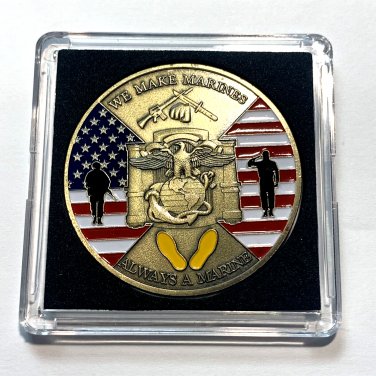
Brand New! Always a Marine Challenge Coin Semper Fi Yellow Foot Print Parris Island w/CaseHigh Quality Bronze Tone and Colored Finish. WITH 2X2 SNAP TIGHT CASE! You will receive one Challenge Coin. Photo depicts front and rear of coin.Fast shipping from USA...High Quality items. 40mm with protective case.USPS First Class Shipping with Tracking.Ships within 24-48 hours from ordering.Perfect gift! ABOUT MARINE CORPS RECRUIT DEPOT-PARRIS ISLAND, SC Marine Corps Recruit Depot Parris Island (often abbreviated as MCRD PI) is an 8,095-acre (32.76 km2) military installation located within Port Royal, South Carolina, approximately 5 miles (8.0 km) south of Beaufort, the community that is typically associated with the installation. MCRD Parris Island is used for United States Marine Corps Recruit Training of enlisted Marines. Male recruits living east of the Mississippi River report here to receive their initial training, as do all female recruits throughout the United States. Male recruits living west of the Mississippi River receive their training at Marine Corps Recruit Depot San Diego, California, but may train at MCRD Parris Island by special request. Marines were first assigned to Parris Island on June 26, 1891, in the form of a small security detachment headed by First Sergeant Richard Donovan, two corporals and 10 privates.[4] This unit was attached to the Naval Station, Port Royal, South Carolina, the forerunner of Parris Island. Donovan's unit was highly commended for preserving life and property during hurricanes and storm surges that swept over the island in 1891 and 1893. Military buildings and homes constructed between 1891 and World War I form the nucleus of the Parris Island Historic District. At the district center are the commanding general's home, a 19th-century wooden dry dock, and an early 20th-century gazebo, all of which are on the National Register of Historic Places.[5] On November 1, 1915, Parris Island was officially designated a Recruit Depot, and United States Marine Corps Recruit Training has continued since then. In the early years of the Marine Corps presence is was referred to as Paris Island.[6] Prior to 1929, a ferry provided all transportation to and from the island from Port Royal docks to the Recruit Depot docks. That year, a causeway and a bridge over Archer's Creek were completed, thus ending the water transportation era. The causeway was dedicated as the General E. A. Pollock Memorial Causeway in April 1984. During the fateful December 1941, 5,272 recruits arrived there with 9,206 arriving the following month, making it necessary to add the 5th, 6th, 7th and 8th Recruit Training Battalions. As the war influx continued, five battalions were sent to New River, North Carolina, to train, and the Depot expanded to 13 battalions. From 1941 to 1945, the Marines trained 204,509 recruits here and at the time of the Japanese surrender, the Depot contained more than 20,000 recruits. On February 15, 1949, the Marines activated a separate "command" for the sole purpose of training female recruits. Later, the command was designated the 4th Recruit Training Battalion, and it now serves as the only battalion in the Corps for training female recruits, and is the only all-female unit in the Department of Defense. The Korean War began in 1950, when 2,350 recruits were in training. From then until the 1st Marine Division withdrew from Korea, Parris Island drill instructors trained more than 138,000 recruits. In March 1952, the training load peaked at 24,424 recruits. The recruit tide again flooded during the years of the Vietnam War, reaching a peak training load of 10,979 during March 1966. On the night of April 8, 1956, the Ribbon Creek incident resulted in the drowning of six recruits, and led to widespread changes in recruit training policies. Supervision of drill instructors was expanded, such as the introduction of the Series Commander. On October 11, 2002, the Town of Port Royal annexed the entire island,[7] but most visitors still associate the installation with Beaufort, a larger community five miles to the north. On June 17, 2011, Brigadier General Lori Reynolds became the first female commander of the base.[8] At the next change of command on June 20, 2014, Brigadier General Terry Williams became the first African-American commander of the base